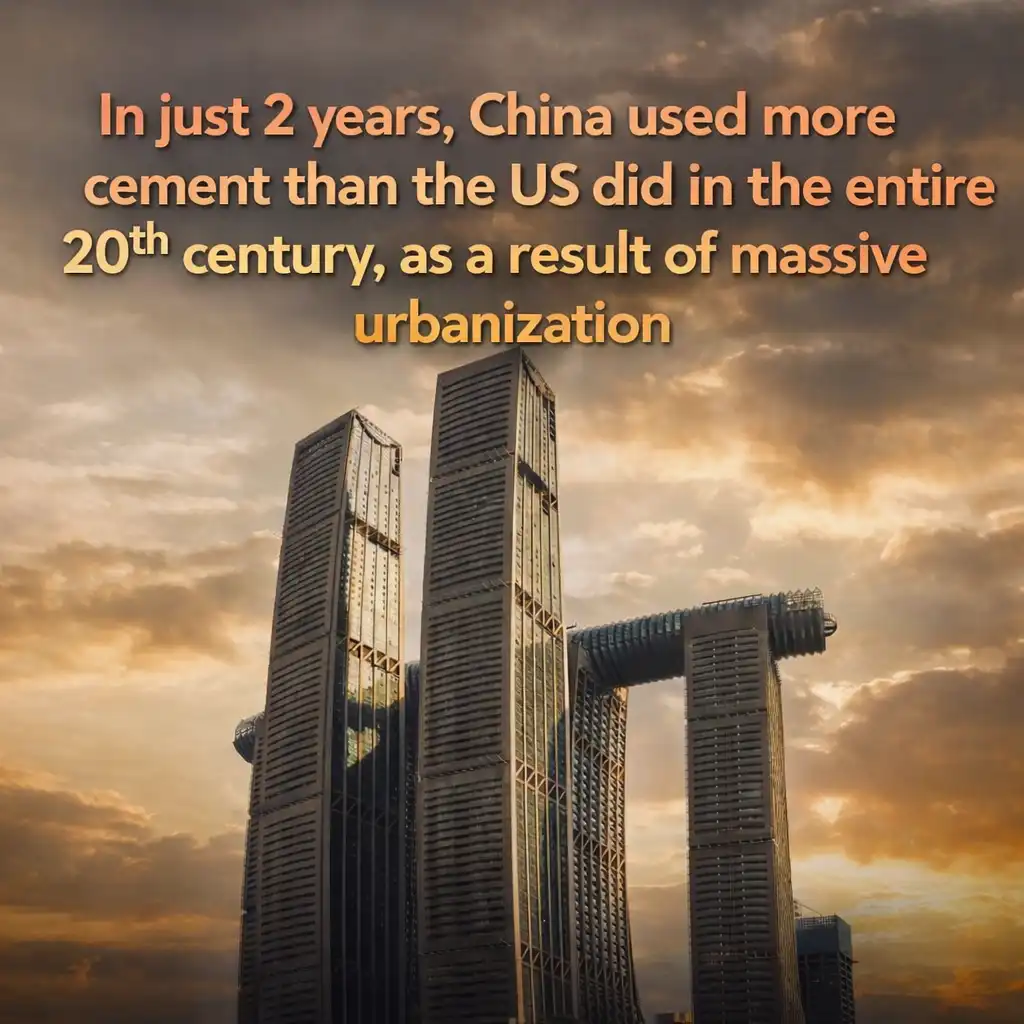

Within just two years—between 2011 and 2013—the People’s Republic of China effectively surpassed the total amount of cement used by the United States throughout the entire 20th century
Within just two years—between 2011 and 2013—the People’s Republic of China effectively surpassed the total amount of cement used by the United States throughout the entire 20th century. During this period, China consumed approximately 6.6 billion tons of cement. By comparison, the United States used a total of about 4.4 billion tons of cement over the full century from 1901 to 2000. This stark contrast clearly illustrates the changing nature of global urbanization and construction dynamics on an industrial scale.
Throughout the 20th century, the United States developed its extensive highway networks, numerous skyscrapers, large industrial zones, and suburban areas based on a long-term, phased development model. This model was shaped by key historical milestones, including the Great Depression, post–World War II urbanization driven by the G.I. Bill, the 1956 Federal-Aid Highway Act, and the waves of suburban expansion during the 1970s and 1980s.
China, by contrast, achieved a comparable scale of infrastructure and urban development in just about 1,000 days. In historical terms, this represents an unprecedented scale and speed. The synchronized operation of industrial production capacity, large construction companies, and state-planned urban development strategies enabled the country to reach extraordinary construction volumes within a very short time frame.
China’s construction model differs significantly from the traditional U.S. model of single-family, wood-frame housing. While “wood-frame housing” has long dominated residential construction in the United States, China has based its urbanization primarily on high-density, multi-story residential buildings, large-scale reinforced concrete structures, major transportation hubs, metro systems, high-speed railways, and multifunctional urban centers. This structural approach accommodates both large-scale migration flows and the expansion of major industrial regions.
This infrastructure surge has also led to significant changes in global material flows. Cement production is one of the largest contributors to industrial carbon emissions. The calcination process involved in Portland cement production generates substantial CO₂ emissions from both chemical reactions and energy consumption. In this context:
– The rapid growth in China’s cement consumption has significantly increased its overall carbon footprint;
– The decarbonization of construction materials (such as alternative binders, carbon capture technologies, and recycled cement components) has become a central topic in global climate strategies;
– Aligning the pace of urbanization with climate commitments remains an ongoing challenge.
China’s large-scale construction activity is not only significant from an urban planning perspective but also from an economic standpoint. The “investment–construction model” became one of the main drivers of China’s GDP growth in the 2010s. In particular, following the 2008 global financial crisis, China structured its economic stimulus programs around large infrastructure projects and sharply increased state investment in this sector.
These indicators demonstrate a fundamental shift in global economic and urbanization trends. Just as America’s industrial legacy set global standards in the 20th century, China has effectively assumed this role in the first decades of the 21st century. This transition is a fundamental macroeconomic factor influencing both price formation in global construction material markets and global carbon strategies.
Source: Smil, V. Creating the Modern World: Materials and Dematerialization. Wiley.